A constellation is truly autonomous only if it does not depend on humans to obtain one of its most fundamental resources: propellant.
This leads to a concept developed by the In-Orbit Refueling Working Group: Autonomous IOR, or Auto-IOR.
Definition: Autonomous constellation system
An autonomous constellation self-manages, maneuvers, self-protects, manages errors and threats, and autonomously refuels. An autonomous constellation can monitor its condition, make operational decisions, maneuver, respond to threats and failures, and optimize its mission operations with only minimal human intervention.
Autonomous operations increase the importance of refueling
More autonomous capability means the spacecraft can potentially:
- perform more RPO missions
- respond to changing mission requirements
- perform more frequent maneuvers
- recover from certain failures
- extend or change mission objectives
But all of this consumes propellant. Thus: More Autonomy → more maneuvering → more propellant consumption → greater need for refueling.
But what happens when the constellation needs propellant?
If a human has to identify a refueling provider, request the service, coordinate the mission, approve the rendezvous, and manage the refueling operation, the constellation is not fully autonomous.
What does autonomous refueling require?
A truly autonomous constellation should be able to:
- Detect the need – “I need propellant.”
- Request propellant – “I need X amount of propellant, of type Y, by time Z, at location/orbit.”
- Select a service provider– Identify an available service provider capable of satisfying those requirements.
- Coordinate Delivery – Arrange the servicing mission, rendezvous, and transfer.
- Execute the Operation – Conduct the refueling operation autonomously or with only appropriate supervisory intervention.
- Verify Delivery – Confirm successful propellant transfer.
All without the need for human intervention. This advancement from IOR to Auto-IOR could enable new levels of autonomous on-orbit services.
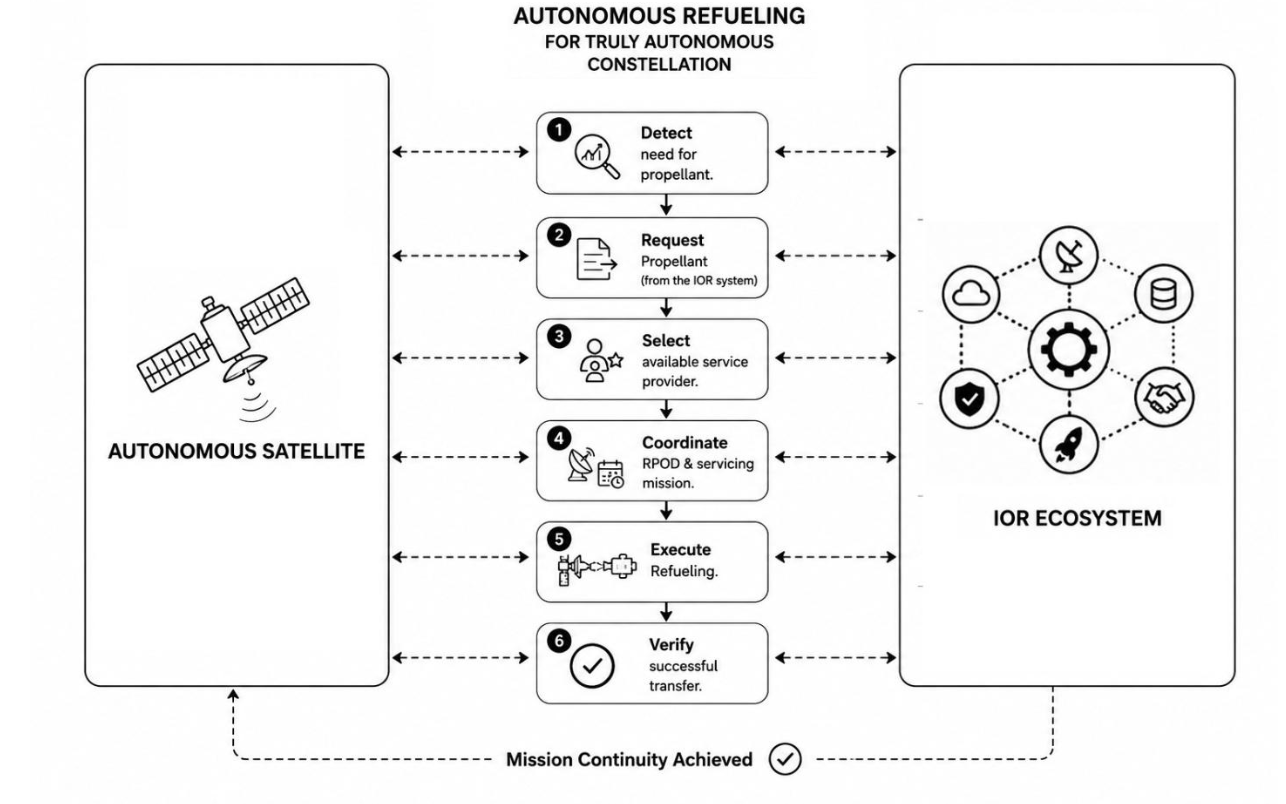
Thus autonomy cannot stop at the spacecraft boundary; it must extend into the logistics infrastructure that supports the spacecraft.
What is missing?
A fully autonomous constellation requires more than an autonomous spacecraft. It requires an Auto-IOR ecosystem. Creating an Auto-IOR requires an interoperable and standardized IOR coordination and interoperability layer that allows autonomous spacecraft and independent service providers to discover, request, coordinate, and execute refueling services.
The interoperable Auto-IOR ecosystem needs to provide ways for:
- Client spacecraft to express a propellant request
- Service providers to advertise capabilities
- Systems to match requirements with available services
- Ground and mission systems to coordinate the operation
- Different spacecraft, tankers, depots, and service providers to exchange information
- The refueling operation to be verified and completed across different vendors
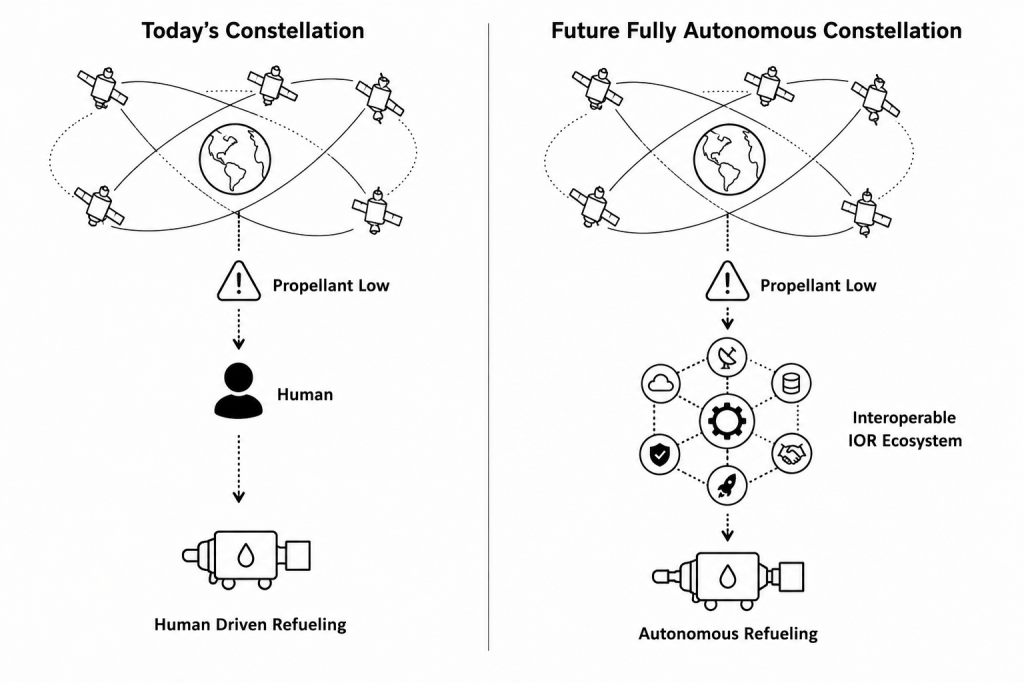
This is essentially the space logistics equivalent of a service interface.
Conclusion
A constellation that can autonomously maneuver, protect itself, recover from failures, and optimize its mission—but still needs humans to arrange its next tank of propellant—is not fully autonomous.
The next frontier of space autonomy therefore requires not only autonomous spacecraft but also autonomous space logistics. Thus – Autonomous decision-making → Resource depletion → Autonomous logistics → Interoperable logistics ecosystem.
The In-Orbit Refueling Working Group is bringing together organizations interested in participating toward an interoperable, globally accessible IOR ecosystem. If your organization believes in the value of open standards and multi-vendor interoperability, learn more at https://inorbitrefueling.org/#faq.