| Document/Purpose | External and Internal Interfaces defined |
| Traceability (Upstream /Downstream) Documents | Upstream: Downstream: System Requirements |
| Status | DRAFT – Ready for Review |
| Baseline Version/Date Current Version | Not yet established | v0.1 |
| Last Updated | |
| Owner / Lead | Sanjay Chadha |
| Contributors | |
| Reviewers | |
| Scope/Out-Of-Scope | Scope: System Design, System Requirements, System Analysis, Out-of-Scope: Physical Architecture |
Table of Contents
- Standard External IOR Interfaces
- Physical (Docking/Transfer)
- Proximity Operations and Relative Navigation
- IOR Capable Chaser (ICAC)/SV ↔︎ IOR Enabled Target (IET) IOR
- IOR Capable Chaser (ICAC)/SV ↔︎ IOR Aware Target (IAT)
- IOR Capable Chaser (ICAC)/SV ↔︎ IOR Cooperative Target (ICOT)
- Chaser Spacecraft <->Target Spacecraft Communication
- IOR Capable Chaser (ICAC) ↔︎ IOR Capable Target (ICAT)
- IOR Service Provider (ISP) <-> Client Operator (CO) Ground Segments
- Refuel Service Related
- IOR Service Provider (ISP) <-> Resupply Service Provider (RSP) Ground Systems
- IOR Service Provider (ISP) Ground Segment ↔︎ Depot
- IOR Service Provider (ISP) Ground Segment (GS) ↔︎ Service Vehicle (SV)
- IOR Service Provider (ISP) Ground Segment <-> IOR Operator (IORO)
- Conjunction Service Provider <-> Ground Segment
- Spacecraft Classification
- Spacecraft State
- RPOD State
- Spacecraft Relative Nav Info
- Spacecraft Return Plan
- IOR Refuel Service Plan
- Abort Command
- Data Structures
- Refuel Service Request
0. Boundaries and Interfaces
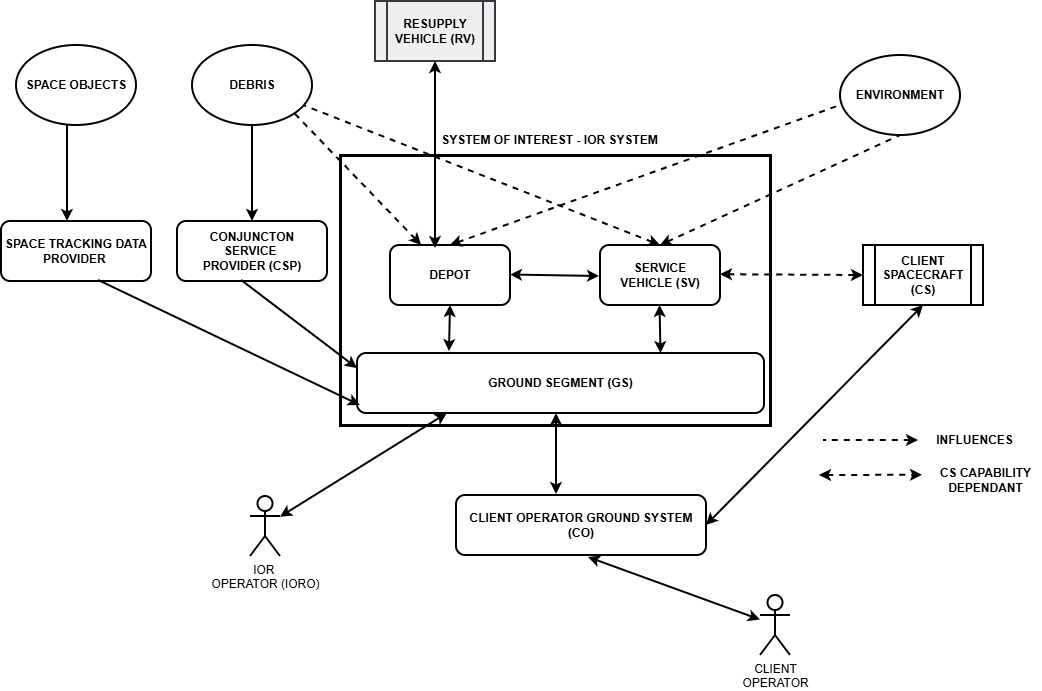
The System of Interest (SoI) is the In-Orbit Refueling (IOR) System, composed of:
- Ground Segment (GS)
- Orbital Depot
- Service Vehicle (SV)
- Resupply Vehicle (RV) [when defined]
External actors include:
- Client Operator Ground System (CO)
- IOR Operator (IORO)
- Client Spacecraft (CS)
- Conjunction Service Provider
- Space Tracking Data Provider – provides orbital data (e.g., TLE/ephemeris) for space objects
- Space Environment / Debris (non-cooperative)
The Functional System Boundary is illustrated in Figure 1:IOR: External and Internal Interfaces. Interfaces in this section are organized as:
- External interfaces: SoI ↔ external actors
- Internal interfaces: interfaces between GS, Depot, SV, and RV within the SoI.
Standard External IOR Interfaces
With the objective of creating a truly common IOR framework, this initiative defines standardized interfaces for:
- Inter-Spacecraft Interfaces
- Physical (Docking/Transfer) – These are the two SERB-approved physical interfaces.
- Proximity Operations and Relative Navigation – Defines how two spacecrafts interact across three supported capability levels: IOR Enabled, IOR Aware, and IOR Cooperative. Definitions are provided in Appendix: 1.11.0: Terminology and Definitions.
- Inter-Ground System Interfaces
- IOR Service Provider <-> Client Operator Ground Systems– Defines how the service provider and client operator coordinates planning, authorization, and execution of services.
- IOR Service Provider <-> Resupply Provider– Supports resupply providers to coordinate and deliver propellant to the service provider in a standardized manner.
- Ground Systems to Spacecraft Interfaces
- IOR Service Provider Ground System <-> Service Vehicle/Depot – Supports command, mission planning, and execution of servicing operations.
- Client Operator Ground System <-> IOR Cooperative Client Spacecraft – Provides telemetry, health monitoring, and coordination support for servicing activities to IOR System
These interfaces are intended to enable companies to develop compliant components and participate in a shared IOR ecosystem.
Inter-Spacecraft Interfaces
Physical (Docking/Transfer)
These are Physical Interfaces between SV, Depot, Client Craft and Resupply Vehicle.
Space System Command’s System Engineering Review Board (SERB) has two approved standard interfaces for satellite refueling –
- Northrop Grumman’s Passive Refueling Module (PRM) and
- Orbit Fab’s Rapidly Attachable Fluid Transfer Interface (RAFTI).
Industry solutions for refueling of National Security Space assets equipped with these SERB-approved interfaces are sought to meet sustained space maneuver (SSM) needs by 2030
Timely: SAM.gov (RFI)
Proximity Operations and Relative Navigation
This section discusses the interface between an IOR Capable chaser and different levels of capability of the target. Definitions of these capability levels are give here.
Client Spacecraft are standardized to enable fuel service delivery. Client Spacecraft can have any one of the four capability levels. Client Spacecraft MUST meet all requirements to qualify for compliance within a capability level. Each proceeding level has all capabilities of the previous level.
IOR Capable Chaser (ICAC)/SV ↔︎ IOR Enabled Target (IET) IOR
There is no communication between the chaser with IOR Enabled chaser.
Physical interface as defined in section Physical Interfaces.
| SNO | Interface Name | SRC | Parameters | Purpose/Type |
|---|---|---|---|---|
| 1 | Fluid Transfer Interface | SV and CS | Physical Interface for transfer |
(TBD: Study the 2 Physical Interfaces)
IOR Capable Chaser (ICAC)/SV ↔︎ IOR Aware Target (IAT)
There is no communication between the chaser with IOR Aware chaser. IOR Aware senses progress and sends the status to the Client Ground Segment.
(more work is required on IOR Aware)
IOR Capable Chaser (ICAC)/SV ↔︎ IOR Cooperative Target (ICOT)
This section provides interface between IOR Cooperative target (ICOT) and IOR Capable chaser (ICAC). The chaser drives the RPOD process with target assisting chaser with status responses and executing commands. ICOT retails safety authority and may reject commands from ICOT if it unable or it is not safe to perform.
Chaser Spacecraft <->Target Spacecraft Communication
Chaser and Target spacecrafts communicate over RF using CCSDS’ Space Packet Protocol.
The ICAC when enters the REP and tries to achieves initial acquisition of the target. Simultaneously the Chaser and Target spacecrafts try to establish an RF link. Once the RF link is established communications as outlined in table below commences:
| SNO | Interface | SRC | DST | Parameters | Purpose/Type |
|---|---|---|---|---|---|
| 1 | Discovery | ICAC | ICOT |
|
Discovery message is sent on entry into REP and continuously sent until DiscoveryAck is received
|
| 2 | DiscoveryAck | ICOT | ICAC |
|
Type: Response |
| 3 | InitiateHandshake | ICAC | ICOT |
|
Initiate communication with ICOT. Type: Status |
| 4 | HandshakeAck | ICOT | ICAC |
|
Confirm two way communication established. Type: Response. |
| 5 | RPODStatus | ICAC | ICOT |
|
Provide chaser navigation and approach state to enable target awareness and coordination Type: Status. |
| 6 | TargetStatus | ICOT | ICAC |
|
Target confirms RPOD status received. Responds with own status. Type: Response |
| 7 | ProximityOperationInit | ICAC | ICOT |
|
First message sent by ICAC to initiate the proximity operations on entry into the AS
Type: Status |
| 8 | ProximityOperationReady | ICOT | ICAC |
|
This message confirms that ICOT is ready for proximity operations. |
| 9 | PerformAttitudeManeuver | ICAC | ICOT |
|
Chaser commands Target to perform Attitude Maneuver. Type: Command |
| 10 | PerformAttitudeManeuverAccepted | ICOT | ICAC |
|
Immediate response providing accepted target.
Type: Response |
| 11 | AttitudeManeuverPerformed | ICOT | ICAC |
|
Target responds with Attitude Maneuver performed.
Type: Response |
| 12 | ReadyToDock | ICAC | ICAT |
|
This is sent when ICAC’s local sensors provide information verifying that docking can proceed
Type: Request |
| 13 | ReadyToDockConfirmed | ICAT | ICAC |
|
Type: Response |
| 14 | DockingInitiating | ICAC | ICOT |
|
Type: Status |
| 15 | DockingComplete | ICAC | ICOT |
|
Type: Status |
| 16 | DockingCompleteConfirmed | ICOT | ICAC |
|
Type: Status |
| 17 | ReadyForFuelTransfer | ICAC | ICOT |
|
Type: Request |
| 18 | ReadyForFuelTransferConfirmed | ICOT | ICAC |
|
Type: Response |
| 19 | FuelTransferInitiated | ICAC | ICOT |
|
Type: Status |
| 20 | FuelTransferComplete | ICAC | ICOT |
|
Type: Status |
| 21 | UndockingInitiating | ICAC | ICOT |
|
Type: Status |
| 22 | UndockingCompleted | ICAC | ICOT |
|
Type: Status |
| 23 | RetreatInitiating | ICAC | ICOT |
|
Type: Status |
| 24 | RetreatCompleted | ICAC | ICOT |
|
Type: Status |
| 25 | ProximityOperationComplete | ICAC | ICOT |
|
This is the last message from ICAC. Type: Status |
| 26 | Abort | ICAC
ICOT |
ICOT
ICAC |
|
Abort Command. On next state start RPOD status with RESUME or RETREAT may be sent. |
| 27 | AbortAck | ICOT
ICAC |
ICAC
ICOT |
|
Abort Acknowledgement |
IOR Capable Chaser (ICAC) ↔︎ IOR Capable Target (ICAT)
Two IOR Capable spacecrafts provide is full two way cooperative RPOD, transfer and return.
The Depot, Service Vehicle (SV), Resupply Vehicle (RV) and the IOR Capable Client Spacecraft (CS) have same capabilities enabling two-way cooperative Proximity Operations. These capabilities are independently verified to be labeled as compliant with this IOR initiative. Details of these capabilities are documented here.
Following is complete pairing of IOR Capable Chaser and IOR Capable Target spacecrafts:
- Chaser: Service Vehicle (SV) Target: Depot | IOR Capable Client Spacecraft
- Chaser: Resupply Vehicle (RV) Target: Depot
Below is Fuel Transfer Supply Relationship:
- Service Vehicle (SV) -> Client Spacecraft
- Resupply Vehicle (RV) ->Depot
Depot may supply to SV but it not as a part of any mission.
IOR Capable Chaser (ICAC) and IOR Capable Target (ICAT) use the same messages as IOR Capable Chaser (ICAC) and IOR Cooperative Target (ICAT) as shown in the previous section.
Depot ↔︎ Service Vehicle (SV)
Depot and Service Vehicle communicates in two states:
Depot↔︎SV: Nominal State Communication
Nominal state is when SV is docked to the Depot. SV and Depot communicate through a physical connector.
| SNO | Interface Name | SRC | Parameters | Purpose/Type |
|---|---|---|---|---|
| 1 | SVSendHealthStatus | Depot | None | Command from Depot to SV to send current health status (polling) |
| 2 | SVHealthStatus | SV |
|
Depot↔︎SV: Proximity Operations
Proximity Operations occurs when SV approaches Depot on return from a fuel delivery service mission. These proximity operation steps between Depot and SV are similar to the proximity operation steps between the SV and IOR Cooperative CS since Depot capabilities match that of an IOR Cooperative Spacecraft. The differences are:
- The fuel is transferred from Depot to the SV
- The SV does not undock and retreat after docking is complete. SV on Docking to Depot reaches a nominal stage and stays until the next service mission.
Depot and Service Vehicle both must be IOR cooperative capable crafts hence must have all capabilities documented here. The Depot and Service follow the process as outlined here.
Resupply Vehicle <-> Depot
Depot and Resupply Vehicle both must have IOR capable level capability hence must have all capabilities documented here. The Resupply Vehicle and Depot follow the process as outlined here.
Inter-Ground System Interfaces
IOR Service Provider (ISP) <-> Client Operator (CO) Ground Segments
Service Request
| SNO | Interface Name | SRC | Parameters | Purpose/Type |
|---|---|---|---|---|
| 1 | RefuelServiceRequest | CO | CustomerID, SpaceCraftID, CapabilityLevel, Spacecraft Kepler Coordinates, Propellant Type, Propellant Amount, Service timeframe | Requests refueling service for a spacecraft, including when propellant is required.
Request time to service time can be up to 1 year. |
| 2 | RefuelServiceResponse | GS | Go/NoGo, spacecraft ID, Service ID, Service Delivery time frame | Returns Go/NoGo decision. If Go, provides the assigned ServiceID and service delivery time frame. The ServiceID is used for all future service‑related interfaces. |
| 3 | BookRefuelService | CO | Service ID | Books the refueling service. The service is now booked for the specified spacecraft. External business transaction must happen before next steps. |
| 4 | CancelRefuelService | CO | Service ID | The service is cancelled. |
| 5 | ConfirmRefuelService | GS | Service ID | Confirms that the external business transaction is complete and the service remains valid. |
Refuel Service Related
| SNO | Interface Name | SRC | Parameters | Purpose/Type |
|---|---|---|---|---|
| 1 | RefuelServiceStart | GS | ServiceID | Refuel Mission Plan is calculated before RefuelServiceStart is sent.
Notifies CO that the service is starting. |
| 2 | RefuelServiceStartStatus | CO |
|
CO confirms to the GS that it is ready to start service. |
| 3 | RefuelServiceStatus | GS |
|
Keeps the CO up to date to status of SV at it progresses through the fuel delivery mission. |
| 4 | ClientSpaceCraftStatus | CO |
|
This message depends on the client spacecraft capability level. These fields apply to spacecraft with capability level: IOR‑ENABLED.
For CS at higher capability level more information would be available. |
| 5 | RefuelServiceComplete | GS |
|
This is sent when propellant transfer is complete, undocking is performed and departure is initiated. |
| 6 | RefuelServiceMissionOver | GS | ServiceID. | This is the last message with the ServiceID. ServiceID is invalid after this message. |
| 7 | RefuelServiceAbort | GS/CO |
|
IOR Services (GS) or Client Operator (CO) can abort the mission at any time; an abort reason must be provided. |
IOR Service Provider (ISP) <-> Resupply Service Provider (RSP) Ground Systems
To be added.
Ground Systems to Spacecraft Interfaces
IOR Service Provider (ISP) Ground Segment ↔︎ Depot
ISP GS↔︎ Depot: Nominal
| SNO | Interface Name | SRC | Parameters | Purpose/Type |
|---|---|---|---|---|
| 1 | DepotOrbitalStatus | Depot | SV/Depot Service Status Fields (SVRPODState) | This interface is invoked both when (1) the Depot is in Nominal Mode and (2) SV return is being performed. The message frequency varies with the service status.
Type: Status |
| 2 | DepotTelemetryData | Depot | Depot and SV’s Telemetry data {Temperature, Battery, Propellant quantity} | Invoked Periodically
Type: Data |
| 3 | MissionPlan | GS | Contact Plan | Provides a 2-hours of Contact Plan window, updated on each reconnect between GS and Depot..
Provides the contact windows on when Depot communicates with Ground Station. Type: Information |
ISP GS↔︎ Depot: Refuel Service
| SNO | Interface Name | SRC | Parameters | Purpose/Type |
|---|---|---|---|---|
| 1 | StartRefuelService | GS | Service ID | Start of Refuel service is notified to both the Depot and SV
Type: Request |
| 2 | StartRefuelServiceReady | Depot |
|
Perform health check before sending Ready
Type: Response |
| 3 | StartRefuelGoNoGo | GS | Final Go/NoGo | This is a final Go/NoGo message sent after Ready is received from CO, Depot and SV.
Type: Command |
IOR Service Provider (ISP) Ground Segment (GS) ↔︎ Service Vehicle (SV)
ISP Ground Segment and Service Vehicle communicate only when SV is undocked. In docking state GS gets all SV info from the depot.
| SNO | Interface Name | SRC | Parameters | Purpose/Type |
|---|---|---|---|---|
| 1 | StartRefuelService | GS | Service ID | Notifies SV that service is starting for ServiceID. Refuel Mission Plan has been computed before this is sent.
Type: Request |
| 2 | StartRefuelServiceReady/
StartRefuelServiceNotReady |
SV |
|
SV perform’s health check before sending Ready. If not ready send ServiceNotReady. Service. GS will continue until StartRefuelServiceReady is received
Type: Response |
| 3 | StartRefuelGoNoGo | GS | Final Go/NoGo | This message sent after Ready is received from all – CO, Depot and SV. Service Plans to SV follow thereafter.
Type: Status |
| 4 | RefuelServicePlan | GS |
Refuel Service Plan (definition) |
Periodically provides updated Refuel Service Plans for both service and return.
Ensures SV can complete service and safely return even if contact with GS is lost. Type: Information |
| 5 | RefuelServiceStatus | SV |
|
Keeps the GS up to date.
Type: Status |
| 6 | AbortRefuelService | GS/CO |
|
Abort Refuel Mission
Type: Command
|
Other External Interfaces
These external interfaces are not standardized under this initiative:
IOR Service Provider (ISP) Ground Segment <-> IOR Operator (IORO)
Admin
Manage Clients – Create, Update and Delete
| SNO | Interface Name | SRC | Parameters | Purpose/Type |
|---|---|---|---|---|
| 1 | ClientCreate | IORO |
|
Create new client record |
| 2 | ClientUpdate | IORO |
|
Update an existing client |
| 3 | ClientDelete | IORO |
|
Remove client record |
Operations
Operate Service Mission – Authorize, Go No/Go
| SNO | Interface Name | SRC | Parameters | Purpose/Type |
|---|---|---|---|---|
| 1 | AuthorizeServiceMission | IORO |
|
Authorize mission execution
Type: Command |
| 2 | GoNoGoDecision | GS |
|
Final readiness gate for mission
Type: Command |
| 3 | MissionControlUpdate | GS |
|
Ongoing ops timeline/status
Type: Status |
Service Mission Monitor
Monitor Service Mission is a browser based dashboard and graphical interface interface to enable the IOR Operator monitor mission and critical data about the mission. The IOR Operator can monitor several missions at the same time.
Conjunction Service Provider <-> Ground Segment
TBD
Exchange Message Structures
Used in several communication – between spacecrafts, spacecraft to ground systems.
Spacecraft Classification
Spacecraft Classification originates at any IOR Capable and IOR Cooperative spacecrafts. This message is exchanged as below:
- IOR Capable Spacecraft <→ IOR Cooperative Spacecraft
- IOR Capable Spacecraft <-> IOR Capable Spacecraft
Spacecraft classification provides spacecraft classification fields to represent the sending spacecraft. Not all fields are useful in all spacecraft to spacecraft interactions.
SpacecraftClassifiction {
  Mode: {SERVICE_VEHICLE, DEPOT, CLIENT_SPACECRAFT}
  CapbilityLevel {IOR_ENABLED, IOR_AWARE, IOR_COO[ERATIVE, IOR_CAPABLE} // Valid when Mode =CLIENT_SPACECRAFT
  ComplianceVersion: String
  InterfaceType interfaceType
  PropellantType propellantType
}
Spacecraft State
Spacecraft State message originates at any IOR Capable and IOR Cooperative spacecrafts. This message is exchanged as below:
- IOR Capable Spacecraft <→ IOR Cooperative Spacecraft
- IOR Capable Spacecraft <→ IOR Capable Spacecraft
Spacecraft State provides following state fields representing the state of the sending spacecraft.
SpacecraftState {
  ThermalInfo thermalInfo;
  PropellantInfo propellantInfo;
}

ThermalInfo {
  ThermalNominal boolean;
  Bus_K   double;
  Propulsion_K double;
}

PropellantInfo {
     PropellantType { HYRAZINE | BIPROPELLANTS | XENON | CRYOGENIC }
     PropellantQuanity_Gms double; // mass in grams
     Pressure_bar double; // in bar
     Temprature_K temp; // in Kelvin
}
RPOD State
RPOD state originates at any IOR Capable spacecraft. This message is exchanged as below:
- IOR Capable spacecraft → Ground Segment
- IOR Capable Spacecraft → IOR Cooperative Spacecraft
- IOR Capable Spacecraft ↔︎ IOR Capable Spacecraft
RPODState {
  RPODControlMode: {GS_CONTROLLED | FULL_AUTONOMOUS | AUTONOMOUS_WITH_GS_AUTH}
          //ControlMode does not generally change, but can change in case chaser looser ground connection

  RPODStatus: {ORBIT_TRANSFER | RENDEZVOUS_ENTRY_POINT_REACHED | FAR_RENDEZVOUS | CLOSE_RENDEZVOUS | PROXIMITY_OPERATIONS | RETURN}  NOMINAL_MODE = SV back with Depot

  // ProximityOperationStatus is used with RPODStatus ==  PROXIMITY_OPERATIONS
  ProximityOperationStatus (POS): {APPROACH | ENTER_HOLD | VERIFY_HOLD | WAIT_FOR_STABILIZATION | RETREAT | PROXIMITY_OPER_ABORT | NOMINAL}

  //ProximityState is used with ProximityOperationStatus == NOMINAL
  ProximityState (PRS): { APPROACH | ALIGNEMENT | DOCK | FUEL_TRANSFER | UNDOCK | RETURN | MISSION_ABORT }
}
Spacecraft Relative Nav Info
Spacecraft Relative Navigation Info originates at any IOR Capable spacecraft during RPOD operations. This message is exchanged as below:
- IOR Capable Spacecraft → IOR Cooperative Spacecraft
- IOR Capable Spacecraft <→ IOR Capable Spacecraft
SpacecraftRelativeNavInfo {
  Ephemeris:  {x, y, z, Vx, Vy, Vz}
  Attitude { pitchAngle, yawAngle, rollAngle }
  InView: Yes | No  // Relaative
  RelativeCooridates { x, y, z }  // meters in ECI framework
  RelativeVelocity {Vx, Vy, Vz} // m/s ECI framework
}
Spacecraft Return Plan
Spacecraft Return Plan is sent by IOR Service Provider GS to SV to enable SV to return to REP to enable RPOD operations with the Depot
This message is exchanged as below:
- IOR Service Provider Ground Station → SV
SpacecraftReturnPlans {
  ReturnTrajectory returnTrajectory; // gets the SV to REP
  ContactPlan contactPlan // Contact Plan for SV to use to communicate with IOR Service Provider GS
  DepotEphemeris Ephemeris;
}
Referenced by AbortRefuelService (GS→SV) and by RefuelServicePlans to ensure consistent abort behavior
IOR Refuel Service Plan
IOR Service Provider GS sends the Refuel Service Plan to provide all the necessary details to the SV/Depot to carry out a refuel service request. The IOR Service GS continues to support the SV through the delivery process.
This message is exchanged as below:
- IOR Service Provider Ground Station → SV
IORRefuelServicePlan {
  RPODToClientSpacecraftPlan rpodPlan;
  ContactPlan contactPlan;
  RefuelServiceRequest refuelServiceRequest;
}
Abort Command
Abort Command can can be initiated by any authorized entity:
- IOR Capable Spacecraft
- IOR Cooperative Spacecraft
- IOR Service Supplier Ground Segment
- Client Operator Ground Segment
AbortType {
    ABORT_TYPE_PROXIMITY_OPS,
    ABORT_TYPE_DOCKING,
    ABORT_TYPE_TRANSFER,
    ABORT_TYPE_MISSION
  }

AbortSource {
  CHASER,
  TARGET,
  SERVICE_PROVIDER_GS,
  CLIENT_OPERATOR_GS
  }

AbortReason {
    ABORT_REASON_PIP_FAILED,
    ABORT_REASON_NAV_FAILURE,
    ABORT_REASON_SAFETY_VIOLATION,
    ABORT_REASON_COMMS_LOSS,
    ABORT_REASON_SYSTEM_FAULT
  }

AbortCommand {
  AbortID int;
  AbortSource {CHASER, TARGET, SERVICE_PROVIDER_GS, CLIENT_OPERATOR_GS}
  AbortType abortType;
  AbortReason abortReason;
  AbortTime time;
  NextStage  {RESUME, RETURN, WAIT_FOR_NEXT_STAGE};
}
Data Structures
These data structures are used by
RPOD to Client Spacecraft Plan
RPODToClientSpacecraftPlan {
  TransferAndOrbitPhasing orbitPhasing; // Tracjectory for Orbit Phasiing
  RendezvousEntryPoint {x, y, z} // in kms ECI
  RendezvousSphere {Cx, Cy,Cz, Radius} // in Kms ECI
  HoldPoints holdPoint[N]; // {x, y, z} // in kms ECI
  ApproachSphere {Cx, Cy,Cz, Radius} // in Kms ECI
  KeepOutSphere {Cx, Cy, Cz, Radius} // in Kms ECI
  ACSphere {Cx, Cy, Cz, Radius} // Approach Corridor Sphere, Radius in m, ECI
  ApproachCorridor {Rbar, VBar, Length,  ACSphere}
}
Contact Window
Contact Window is the time window when two entities can contact each other
ContactWindow {
   ContactType {RF_LSL, RF_HSL} // Low speed, High speed links
   StartTime time;
   EndTime time;
   Entity entityDst;
   RequiresPointing boolean;
   PointingDirection {x, y, z};
}
Contact Plan
Contact Plan Windows SV/Depot to communicate through during service delivery
ContactPlan {
      Entity entitySrc;  // Who is the contact plan for
      ContactWindow contactWindow[ContactPeriod]
}
Refuel Service Request
Refuel Service Request is what was received from the client either manually or from the Client Operator Ground Segment.
RefuelServiceRequest {
  Client Spacecraft ID
  ClientType
  Propellant type
  Requested volume
  Client spacecraft ephemeris data
  Abort/Return Plan Reference
  SV Abort/Return Plan
}