In-Orbit Refueling (IOR) has the potential to extend satellite life, improve constellation economics, and enable new space logistics capabilities. But for IOR to become a scalable commercial service, the industry needs more than individual refueling technologies. It needs interoperability and standardization.
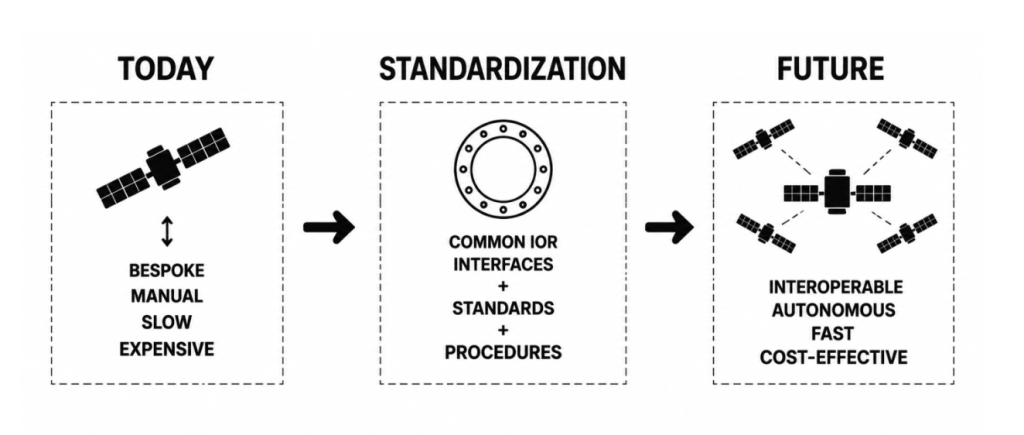
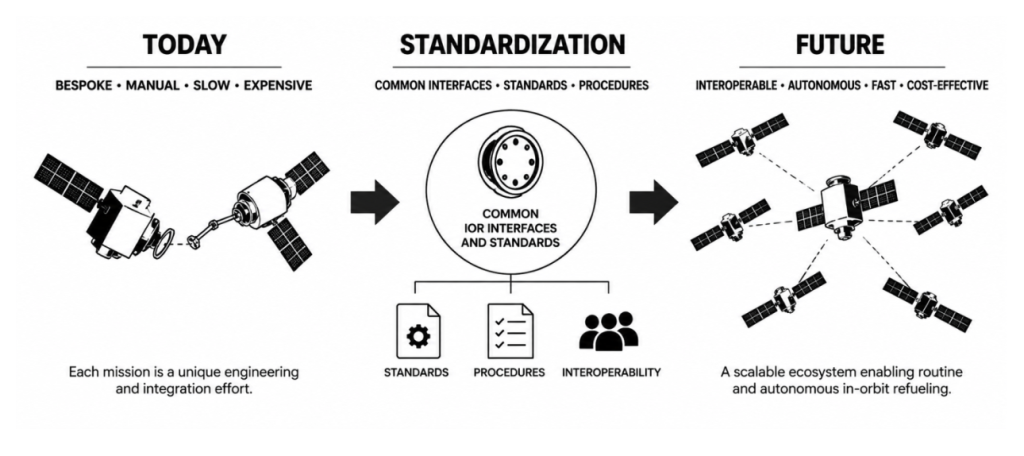
Today, many elements of the IOR ecosystem are being developed by different companies, using different interfaces, technologies, procedures, and approaches. Without greater interoperability, every refueling mission risks becoming a bespoke engineering and integration exercise.
Standardization can help change that.
Here are 10 reasons why standardization is important for the future of In-Orbit Refueling.
1. Reduce the Cost of Propellant Delivery
For IOR to become commercially attractive, the cost of extending a satellite's operational life through refueling needs to be economically competitive with, or sufficiently justified against, satellite replacement.
Standardized interfaces, procedures, and operational approaches can reduce the engineering and integration effort required for individual servicing missions.
2. Make Refueling Services Easier to Request and Access
A bespoke refueling solution can be difficult, slow, and costly to arrange.
A standardized ecosystem can make the process much simpler.
Instead of developing a unique technical and operational solution for every spacecraft and service provider, operators could identify compatible refueling services and request them using common interfaces, procedures, and service definitions.
3. Improve the Economic Viability of IOR Service Providers
IOR service providers need both lower costs and a sufficiently large addressable market.
A standardized ecosystem allows multiple companies to provide complementary technologies and services rather than requiring one company to develop the entire IOR capability.
Specialization can reduce development costs, while interoperability can allow providers to serve a larger customer base.
This creates the possibility of a more sustainable IOR business model.
4. Increase Competition and Foster Innovation
A fully integrated, proprietary ecosystem can make it difficult for smaller companies to participate.
Open standards and interoperable interfaces can allow companies to specialize in individual parts of the IOR value chain.
For example, different companies could develop:
- Refueling interfaces
- Propellant transfer systems
- RPOD systems
- GNC technologies
- Sensors
- Thrusters
- Autonomous operations
- Simulation and mission-planning systems
This creates opportunities for competition, specialization, and innovation.
5. Reduce the Cost of Providing Servicing Coverage
Space is large.
Satellites operate across VLEO, LEO, MEO, and GEO, creating a significant challenge for service providers seeking broad coverage.
A service provider may not be able to economically maintain dedicated capabilities for every orbital region.
An interoperable ecosystem can allow different providers and spacecraft to cooperate, potentially making broader servicing coverage more economically achievable.
6. Reduce Failures and Improve Operational Reliability
Rendezvous, proximity operations, docking, and propellant transfer are complex operations.
When spacecraft are designed around compatible interfaces and predictable procedures, there is less uncertainty about how systems will interact.
Standardization can therefore reduce incompatibilities and integration risks and improve operational predictability.
7. Increase the Speed of Service Delivery
Every bespoke mission requires engineering, integration, testing, coordination, and operational planning.
Common interfaces and procedures can reduce these activities.
Standardized spacecraft can potentially perform rendezvous, alignment, docking, and propellant transfer with fewer integration and operational delays.
8. Enable Standardization at the Subsystem and Component Level
Standardization does not need to stop at the spacecraft interface.
As system-level interoperability develops, it can eventually encourage greater standardization at subsystem and component levels.
This could include technologies such as:
- LiDAR
- GNC systems
- Thrusters
- Sensors
- Communications
- Docking mechanisms
The objective is not necessarily to make every component identical.
9. Enable Faster and More Scalable Refueling
The future space environment could contain thousands—and potentially tens of thousands—of spacecraft.
These spacecraft will not require propellant at the same time or in the same orbit.
A scalable IOR ecosystem therefore needs to support many distributed servicing requirements.
Standardization can make it easier for service providers to respond to these requirements without creating a completely new technical solution for every spacecraft.
10. Enable Fully Autonomous Constellations
This may ultimately be the most important reason for standardization.
As spacecraft and constellations become increasingly autonomous, they will need to perform activities such as refueling with minimal human intervention.
An autonomous spacecraft cannot efficiently negotiate a completely bespoke technical process every time it needs propellant.
It needs predictable:
- Interfaces
- Procedures
- Service definitions
- Information exchanges
- Operational interactions
Standardization provides the foundation for this level of autonomy.
From Individual Refueling Missions to an IOR Ecosystem
The fundamental issue is therefore bigger than the refueling interface itself.
IOR needs to evolve from individual, bespoke servicing missions into an interoperable ecosystem.
That requires coordination between:
Spacecraft → Refueling Interfaces → Service Providers → Propellant Providers → RPOD → Mission Operations → Autonomous Logistics
The more standardized and interoperable these elements become, the easier it becomes to build a scalable commercial market.
The Ultimate Objective
Make In-Orbit Refueling easy to access, economically viable, scalable, and eventually autonomous.
The In-Orbit Refueling Working Group is working with organizations interested in developing a globally interoperable IOR ecosystem based on standardization, coordination, and multi-vendor interoperability.
Interested in participating?